The Bloodworks
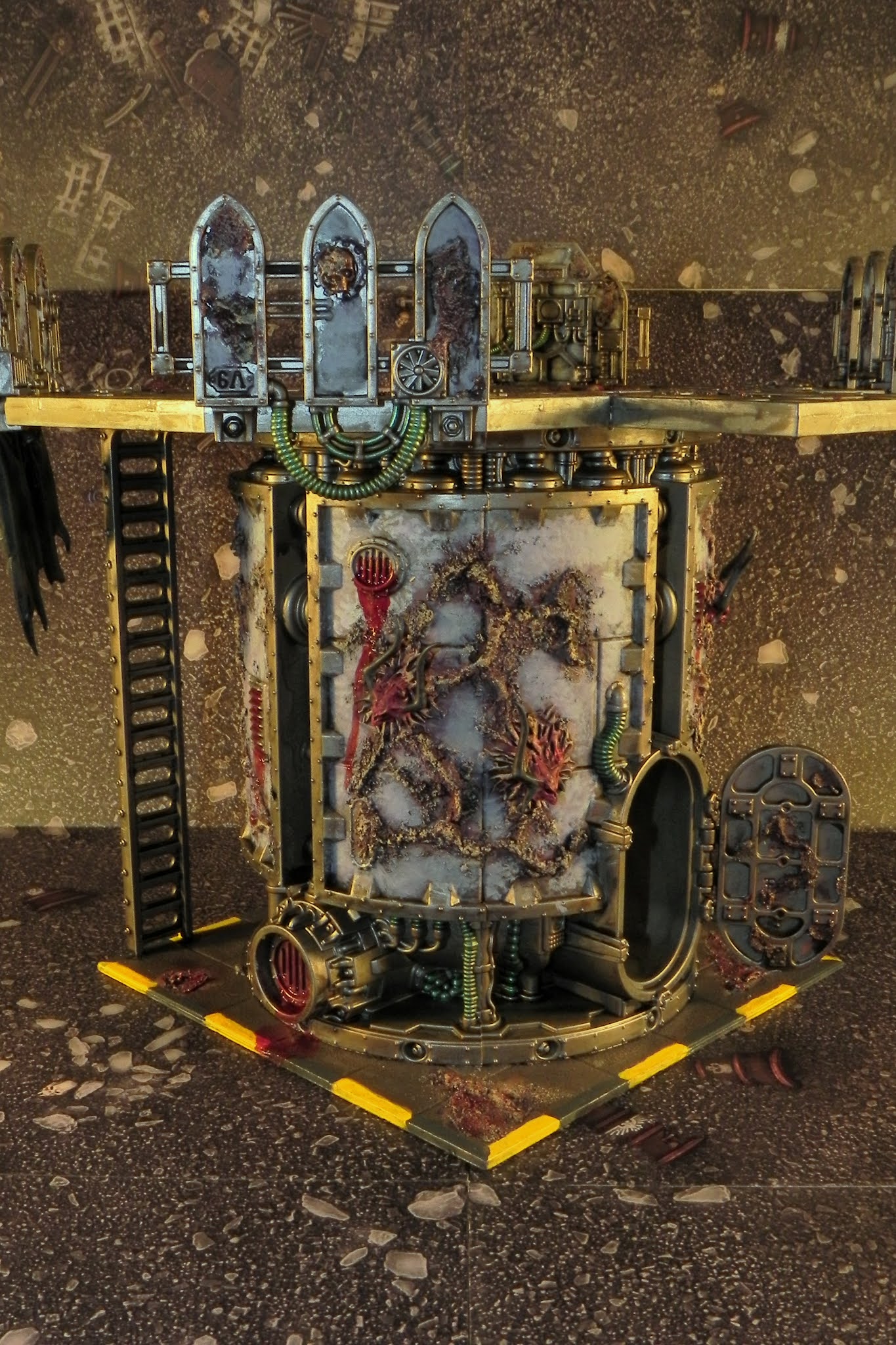
On its way from the Sanguinal Refineries to the Cranic Furnaces the mixture of promethium, blood and daemonic ichor travels and is stored and stabilised in a network of Haematic Plasma Regulators and Condutis. Much like the other Belochian structures claimed by the servants of Khorne, this machinery is slowly turning into organic structures, the conduits ever more resembling blood vessels while the plasma coils contract and beat like cardiac muscles. The tanks and heat vents' sides bleed from never-healing wounds on their flanks and skulls are tossed around, often piled into impromptu altars to the Red God. The reek of blood clings to the air, as does the faint echo of a laughter coming from the Skull Throne.
Recently I've started playing Kill Team relatively regularly and that motivated me to get back to this terrain project. These are all relatively small pieces made with a combination of bits from the Sector Mechanicus kits I assembled in the past, plastic piping and even a plastic container for toothpicks.
The strainght pipes are cut to the same length as the gantries of the Hanging Ways, just like the original Thermic Plasma Conduits. The curved one is only a few centimetres smaller than the angled walkways I stil have to assemble, but I couldn't find anything of the exact same size. The veins crisscrossing them are sculpted with greenstuff.
The ladder going up the vent is made using cleaned up sprues.
The Thermic Plasm Regulator is converted exactly like the Sanguinal Refinery, with bone spurs from the Ogor Mawtribes range, Khornate symbols and trophies and also the horns with dangling skulls from the Black Orcs banner.
Finally I had the hatches from the STC Ryza-pattern Ruins to which I simply glued some skulls. They're the only pieces that have not been smeared with my home-made texture (coffe grounds and PVA) to represent the wounds on the sides of the structures.
The palette is essentially the same as the other pieces. However, this time I've used an iron mica effect enamel spray for the undercoat rather than Leadbelcher spray, resulting in slightly darker tones.
As always, every piece is perfectly sized to match the others, either to join at ground level or to sit on top of larger pieces.
The Hanging Ways
On Beloch, walkways and pulleys serve more purposes than simply moving slaves and goods between the hellish facilities. The raised platforms see many a warlord marching across them, hundreds of slaves behind them, to celebrate their triumphs in plain sight of followers and rivals alike. Tattered banners and trophies hanging from the railings stand as testament to their glory and that of the Dark Gods. Underneath them hang the bodies of slaves that tried to rebel or failed to fullfil their quotas. Fresh victims are constantly spiked on hooks and hoisted up, the previous bodies unceremoniously piled at the walkways feet. Everything is left there, flesh quickly consumed by the acidic vapours filling the air, to remind everybody else of the price paid for displeasing Beloch's masters.
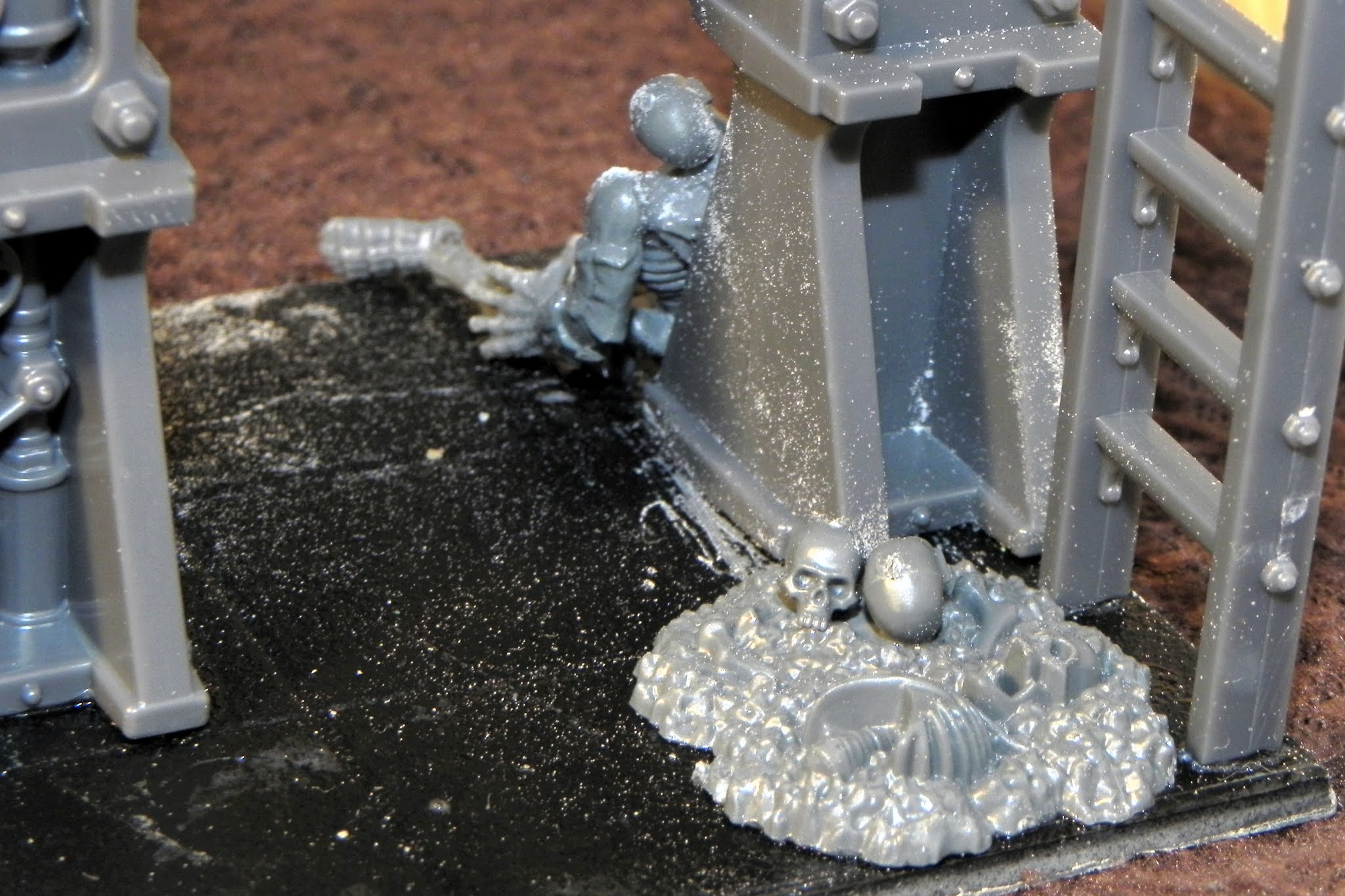
I've kept the conversion work on the straight walkways rather minimal, only repositioning three old Khemri skeletons to represent the dead slaves. I then used a few more chopped up skeleton and zombie bits, some skulls and the Necromancer base topper for the piles of broken bodies on the bases of the models. On all of them, I've added some texture created by sprinkling bicarbonate of soda on blobs of superglue.
The bestial skulls were perfect to add a macabre touch to the railings while also subtly altering their silhouette. The flag poles on the railings are the bottom part of the banner staff from the ogor kits. Once they were bonded to the railings, I dropped some superglue along them and placed the centre of strips of cloth on top. Before folding the cloth, I smeared liquid greenstuff on it, pressed the two halves together until they were stuck and then gently brushed them with a wet brush to ensure the greenstuf spread to the whole cloth. The weight of the cloth itself and the angle at which it was hanging ensured that it folded in a natural way which was fixed as the greenstuff cured.
The painting followed the same palette and techniques I've used on the Warp Foundries while the skeletons and body parts were painted like the skulls and texture on the Sanguinal Refinery, with the subtle difference that this time I wet-blended God for the Blood God with Typhus Corrosion.
The skull on the pulley is in painted in brass and the banners in black to further link the Hanging Ways to the cranic Furnace anbd the Sanguinal Refinery.
Like the Sanguinal Refinery, the Hanging Ways comprise two smaller pieces to give me more set up options and add variety between games.
This would already be enough for an average Kill Team board, but I still have a pair of angled walkways, one Thermic Plasma Regulator and plans for a few scratch-built scatter terrain pieces that will bring Beloch to a densly packed, single Kill Team board (the ones I prefer!) or for a regular multi-player board.
The Sanguinal Refinery
In order to fuel the Cranic Furnaces, the servants of Khorne have corrupted many Promethium Forges, their flanks punctured by sharp bone growths and constantly oozing blood. Screaming prisoners are brought to the top, their throats sliced and the gushing vitae poured into the hatches to be mixed with promethium and daemonic icor. As the refineries churn into action and ruddy smog belches from the vents, the drained bodies are tossed at the feet of the structures. There, to the ringing of brass bells and gongs, their heads are removed, flensed and offered to snarling effiges of the Blood God. And as souls are dragged screaming into the Warp, their headless bodies are carried away to feed the throngs of slaves working the infernal machineries.
For the Sanguinal Refinery I've again used a texture made with coffe grounds and PVA glue. This time, I've generously smeared it across the sides of the structure rather than applying it in long strings. I've also added some tusks from the Mournfang Pack kit to the sides of the pipe and half Malevolent Maelstrom to the base, hiding the joint with skulls.
The Ironguts banner top has exactly the same diameter as the large vents on the Sector Mechanicus range and once painted as brass is a perfect Khornate symbol. The addition of more bloodied skulls piled around the base of the Refinery complement those in the jaws of the symbol. A few chains, bells, banner tops and gongs fished from my bits box completed the desecration of the Refinery.
The colour scheme is exactly the same as that of the Cranic Furnace, although the texture was finished with a generous coating of Blood For The Blood God rather than a drybrush of Cadian Fleshtone, giving the feeling of fresh blood rather than scabbing tissue. I've also stippled Blood For the Blood God all over the platform and have been more generous with the amounts leaking from the pipes. The Malevolent Maelstrom was drybrushed from bright yellow to red, rather than in the greens I've used on the Warp Foundries, to better fit the Khornate theme.
The Sanguinal refinery is, in fact, two smaller pieces of terrain, allowing for plenty of flexibility in how it can be combined with the Cranic Furnace and the Warp Foundries.
The Cranic Furnace
Those Ferratonic Furnaces that have fallen into the hands of Khorne's followers have been quickly repurposed into sacrificial altars. Many Khorne-touched champions emerge from the nearby Karsayon Vortex and ply the starts towards Beloch, their ship hulls brimming with skulls collected on hundreds of battlefields in the Imperium Nihilus. Upon arrival, the skulls are poured into the furnaces and doused with an unholy mixture of blood, promethium and daemonic ichor. The furnaces are then turned on, immolating the bounty of skulls to the Blood God and beseeching Him for daemons to be bound into vehicles and weapons.
Over time, the paintwork on the sides of the furnaces has taken on the hue of bruised flesh, criss-crossed by scabbing tissue. The wounds never fully heal, as they open up again every time the Cranic Furnaces are turned on and more Khornate daemons push themselves into reality.
I've painted the Cranic Furnace roughly using the same techniques and palette as on the Warp Foundries: drybrushing (Hashut Copper on the metal, Bugman's Glow on the fleshy texture, Mephiston Red on the Blodletter heads) and stipling (Ulthuan Grey on the sides of the furnace) followed by washes (Carrobourg Crimson and Druchii Violet on the daemons and flesh, Agrax Earthshade on the metal, Nuln Oil on the side of the furnaces) over a Leadbelcher basecoat.
This time, however, I've tried to do some wet-blending so that the washes used on the Bloodletter heads and fleshy texture mixed with the wash and stipling on the sides of the furnace. The wet-blending was then followed by a second round of drybrushing: Ironbreaker on the metal, Gehenna's Gold on the Khornate symbols, Cadian Fleshtone on the fleshy texture and Wazdakka Red on the Bloodletter heads.
I then picked up the Bloodletters' horns in Skavenblight Dinge followed by an highlight of Eshin Grey. This sequence was used for the banner and black hazard stripes as well. The yellow stripes were done in Averland Sunset and Yriel Yellow. I also painted the ridged cables in an old Citadel metalic green paint, to tie the piece to the green used on the daemonic energies in the Warp Furnaces.
The skulls got a coat of Administratum Grey, a glaze of Skeleton Horde and a drybrush of Tyrant Skull before being smeared with Blood for the Blood God. Blood for the Blood God was also used on the texture on the floors and to paint the leaks from the grids and pipes and the Khorne rune on the banner.
The final result is exactly what I wanted: distinct from the Warp Foundries, but still looking as if they belong to the same setting.